

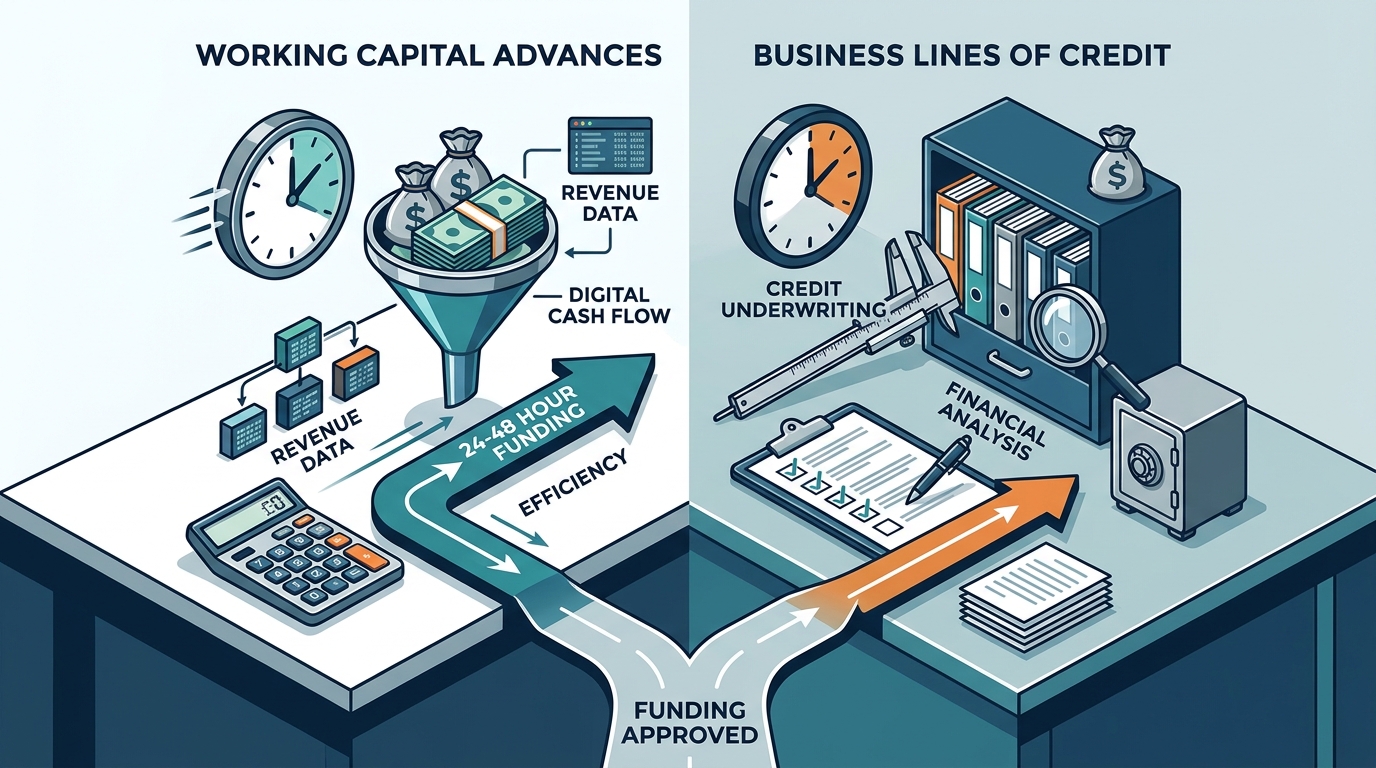
Working capital advances typically suit companies needing funds in 24 to 48 hours better than business lines of credit. Advances often process faster because they rely on revenue data rather than complex credit underwriting. This guide covers how to choose, verify, and cost these options for rapid funding.
How to Choose: Separating Good Options from Bad Ones
Choosing the right funding source requires understanding the structural differences between products. A working capital advance is a purchase of future receivables where the provider buys a portion of your future sales. A business line of credit is a revolving facility that allows you to borrow, repay, and borrow again up to a limit. For a 48-hour deadline, the speed of underwriting is the primary differentiator.
Advances often move faster because they focus on cash flow and bank deposits. Lines of credit may require more traditional credit checks and financial statements. If your business has strong, consistent revenue but a lower credit score, an advance may be the faster path. If you have established credit and need flexible, recurring access, a line of credit might be better, though it may take longer to approve.
What to Ask: Specific Questions Before Committing
Before signing any agreement, you must ask specific questions to avoid hidden costs. Do not rely on marketing claims alone. Ask the provider for the total cost of funding, not just the monthly payment. For advances, ask for the factor rate. For lines of credit, ask for the APR and any fees.
Key Questions for Speed
- What is the exact timeline from application to funding?
- What documents are required, and can they be uploaded digitally?
- Is there a dedicated point of contact for my application?
Key Questions for Cost
- What is the total amount I will repay?
- Are there prepayment penalties?
- What happens if my revenue drops?
How to Verify: Checking Claims and Credentials
Verification is critical in the commercial financing space. Many providers operate as brokers rather than direct lenders. You should verify who the actual funding source is. Ask for the name of the third-party lender or funding provider. Check their registration status in your state. In states like New York and California, commercial financing brokers must often be registered or licensed.
Verify the provider's physical address and contact information. A legitimate firm will have a verifiable office location and a professional website. Avoid providers that only communicate via text message or unbranded email addresses. You can also check for reviews on independent platforms, but be wary of fake reviews.
How It Works: Process and Timeline
Step 1: Application
You fill out an online form with basic business details. This takes 5 to 10 minutes.
Step 2: Document Submission
You upload bank statements, tax returns, and financial statements. For advances, 90 days of bank statements are often sufficient. For lines of credit, you may need 2 years of tax returns.
Step 3: Underwriting
The provider reviews your cash flow and credit. Advances may approve in hours. Lines of credit may take 2 to 3 business days.
Step 4: Funding
Once approved, you sign the agreement. Funds are deposited via ACH. This can take 24 to 48 hours.
What It Costs: Drivers of Price
Several factors drive the price up or down. Higher revenue generally leads to lower costs. Longer terms can lower monthly payments but increase total cost. Stronger credit scores typically result in lower APRs for lines of credit. For advances, consistent cash flow is the primary driver of the factor rate.
What Goes Wrong: Common Mistakes
Business owners often make mistakes that delay funding or increase costs. The most common mistake is not having documents ready. If you cannot provide bank statements quickly, your 48-hour deadline will slip. Another mistake is not reading the fine print. You must understand the repayment structure. For advances, repayment is often a daily or weekly percentage of sales. If sales drop, your repayment period extends.
Avoid taking on more debt than you can service. Calculate your maximum affordable payment before applying. If you are unsure, consult with a financial advisor. Do not assume that a lower monthly payment means a lower total cost.
Versus Alternatives: Comparing Options
Working capital advances and lines of credit are not the only options. Other alternatives include term loans, SBA loans, and credit cards. Each has different speed and cost profiles.
| Product Type | Typical Speed | Cost Structure | Best For |
|---|---|---|---|
| Working Capital Advance | 24-48 Hours | Factor Rate | Fast cash flow needs |
| Business Line of Credit | 2-3 Business Days | APR | Recurring, flexible needs |
| Term Loan | 1-2 Weeks | Fixed Interest | Large, long-term purchases |
| SBA Loan | 30-60 Days | Low APR | Long-term growth |
For a 48-hour deadline, term loans and SBA loans are generally too slow. Credit cards can be fast but often have high APRs and lower limits. Advances and lines of credit are the most viable options for rapid funding.
For a Specific Situation: Retail vs. Service
The best option depends on your business model. For a retail business with high, seasonal sales, a working capital advance may be ideal. It aligns repayment with revenue. For a service business with steady, predictable invoices, a line of credit may be better. It offers flexibility to draw funds only when needed.
If you are a restaurant, consider the volatility of your sales. Advances may be riskier if sales drop unexpectedly. A line of credit with a fixed APR might provide more stability. Always match the product to your cash flow pattern.
Rules and Protections: Legal and Regulatory
Commercial financing is subject to state and federal regulations. In New York and California, brokers must comply with specific disclosure and registration laws. You have the right to receive a clear summary of terms before signing. This includes the total cost, repayment schedule, and any fees.
Under the Truth in Lending Act (TILA), certain business loans must disclose APR and finance charges. While not all commercial financing is covered by TILA, reputable providers will still provide clear cost disclosures. Always read the agreement carefully. If a term is unclear, ask for clarification in writing.
Local Specifics: New York and California
Creative Capital Solutions operates in Manhattan, New York, and Los Angeles, California. Both states have specific regulations for commercial financing. In New York, the Department of Financial Services (DFS) oversees certain lending activities. In California, the Department of Financial Protection and Innovation (DFPI) regulates lenders and brokers.
When working with a provider in these states, verify their compliance. Ask for their license number or registration status. This ensures you are dealing with a legitimate entity. Local market conditions can also affect funding availability. In competitive markets, providers may offer more favorable terms to attract business.
Timing: When to Act
Timing is critical when you need funds in 48 hours. Apply as early as possible. Do not wait until the last minute. Underwriting can take longer than expected if there are issues with your documents. Submitting complete, accurate documents on day one can save days.
Consider the day of the week. Applying on a Friday may delay funding until the following week. Apply on a Monday or Tuesday for the best chance of 48-hour funding. Also, consider the time of day. Applying in the morning gives the provider more time to process your application.
Results Over Time: Long-Term Outlook
Using working capital advances or lines of credit can help your business grow, but it also adds debt. Over time, you should aim to reduce your reliance on short-term funding. Use the funds to generate revenue that can pay off the debt. For advances, this means increasing sales. For lines of credit, this means using the funds for investments that yield returns.
Monitor your debt-to-equity ratio. High debt levels can make it harder to secure future funding. Aim to pay off the advance or line of credit as quickly as possible. This improves your financial health and credit score. Over time, you may qualify for lower-cost financing options.
Key Takeaways
- Working capital advances are faster than lines of credit for 48-hour funding.
- Advances are purchases of future receivables, not loans.
- Lines of credit offer flexibility but may take 2-3 days to approve.
- Always verify the provider's license and registration status.
- Ask for the total cost of funding, not just the monthly payment.
- Have your documents ready to avoid delays.
- Match the product to your business model and cash flow pattern.
- Use the funds to generate revenue that can pay off the debt.
Frequently Asked Questions
Is a working capital advance a loan?
No. A working capital advance is a purchase of future receivables. It is not a loan. You do not pay interest; you pay a factor rate on the amount advanced.
How fast can I get funds with a working capital advance?
Funding can occur in as little as 24 to 48 hours, depending on the provider and your documentation.
How fast can I get funds with a business line of credit?
Business lines of credit typically take 2 to 3 business days to approve and fund.
What documents do I need for a working capital advance?
You typically need 90 days of bank statements, business tax returns, and a business license.
What documents do I need for a business line of credit?
You typically need 2 years of business tax returns, financial statements, and bank statements.
Can I get funding with bad credit?
Credit is not the only factor. Providers may consider your cash flow and revenue. Bad credit is considered, but it may affect the terms.
Are there prepayment penalties?
It depends on the provider and product. Some advances allow prepayment without penalty. Some lines of credit may have prepayment penalties. Always ask before signing.
Is Creative Capital Solutions a direct lender?
No. Creative Capital Solutions is a commercial financing broker. We connect businesses with third-party funding providers.
Conclusion
For companies needing funds in 24 to 48 hours, working capital advances are generally the faster option. Business lines of credit offer more flexibility but may take longer to approve. Choose the option that best fits your business model and cash flow. Creative Capital Solutions can help you navigate these options and connect you with the right funding provider. Apply now to get started.